The QBI Deduction Explained: How the 20% Pass-Through Deduction Works in 2026
The qualified business income deduction, created in 2017 under Section 199A of the tax code, allows owners of sole proprietorships, partnerships, LLCs, and S corporations to deduct up to 20% of their qualified business income. It was scheduled to expire after 2025. The tax law passed in July 2025 made it permanent, widened the income range where it phases out, and added a small minimum deduction starting in 2026. For many owners it is the single largest deduction on their return, and it is often misunderstood.
Who Qualifies
The deduction is available to individuals, and some trusts and estates, with income from a trade or business operated as a sole proprietorship, partnership, LLC, or S corporation. It also covers qualified REIT dividends and certain publicly traded partnership income. C corporations do not qualify, and neither does W-2 wage income from an employer.
The deduction is taken on your personal return. It reduces taxable income but not adjusted gross income, and you can take it whether you itemize or use the standard deduction.
What Counts as Qualified Business Income
Qualified business income is the net profit from a qualified trade or business. Several items are specifically excluded:
- Reasonable compensation paid to you as an S corp shareholder
- Guaranteed payments to you as a partner for services
- Interest, dividends, and capital gains, even if earned inside the business
- Income from a business conducted outside the United States
The Simple Case: Income Below the Threshold
If your 2026 taxable income before the QBI deduction is $201,750 or less ($403,500 or less for married couples filing jointly), the calculation is straightforward. Your deduction is generally 20% of your qualified business income, limited to 20% of your taxable income minus net capital gains.
A married consultant has $250,000 of qualified business income and $300,000 of taxable income before the deduction. Because taxable income is below $403,500, the deduction is 20% of $250,000, or $50,000. That is less than 20% of taxable income ($60,000), so the full $50,000 is allowed.
Above the Threshold: Two Limits Phase In
Above the threshold, the limits phase in over the next $75,000 of taxable income for single filers and $150,000 for joint filers. They apply in full once taxable income reaches $276,750 single or $553,500 married filing jointly for 2026.
- The wage and property limit: the deduction for each business cannot exceed the greater of 50% of the W-2 wages it pays, or 25% of W-2 wages plus 2.5% of the original cost of its depreciable property. A business with no employees and little equipment can lose most of the deduction.
- The specified service limit: income from a specified service trade or business is phased out entirely above the range. That includes health, law, accounting, consulting, financial services, brokerage, athletics, performing arts, and any business whose main asset is the reputation or skill of its owners or employees.
The New $400 Minimum
Starting in 2026, taxpayers with at least $1,000 of qualified business income from businesses in which they materially participate get a minimum deduction of $400. This mainly helps owners with small side businesses whose deduction would otherwise be smaller than that. The amount will be adjusted for inflation starting in 2027.
How Your S Corp Salary Affects the Deduction
For S corp owners, salary and the QBI deduction pull in opposite directions. Salary is not qualified business income, so a higher salary reduces the base for the 20% deduction. Above the threshold, though, the deduction is limited by W-2 wages paid, and your own salary counts. For some owners above the threshold, raising salary actually increases the deduction.
This is why S corp salary should be set with the QBI deduction in mind, not just payroll taxes. The right answer is specific to your income, your industry, and whether you have other employees.
Rental Real Estate
Rental income qualifies only if the rental activity rises to the level of a trade or business. The IRS offers a safe harbor for rental enterprises that perform at least 250 hours of rental services a year and keep separate books and records. Many single-property landlords do not meet it, and triple net leases are excluded from the safe harbor.
When the Deduction Does Not Help
The deduction does not apply to W-2 employees, C corporation income, or investment income. High-income owners of service businesses such as consulting, medical, law, and financial practices lose it completely once taxable income passes the top of the phase-in range. Restructuring a service business just to qualify, for example by splitting off a separate entity, has been addressed by IRS regulations and rarely works as promoted.
References

Daniel is a Florida CPA and the principal of MDR Consulting CPA PLLC in Miami. He works with small businesses, self-employed professionals, and high earners on tax compliance and planning, in English and Spanish. Before starting the firm he led accounting and finance teams as VP of Finance at Alivi and Director of Accounting at Assurant.
More about Daniel →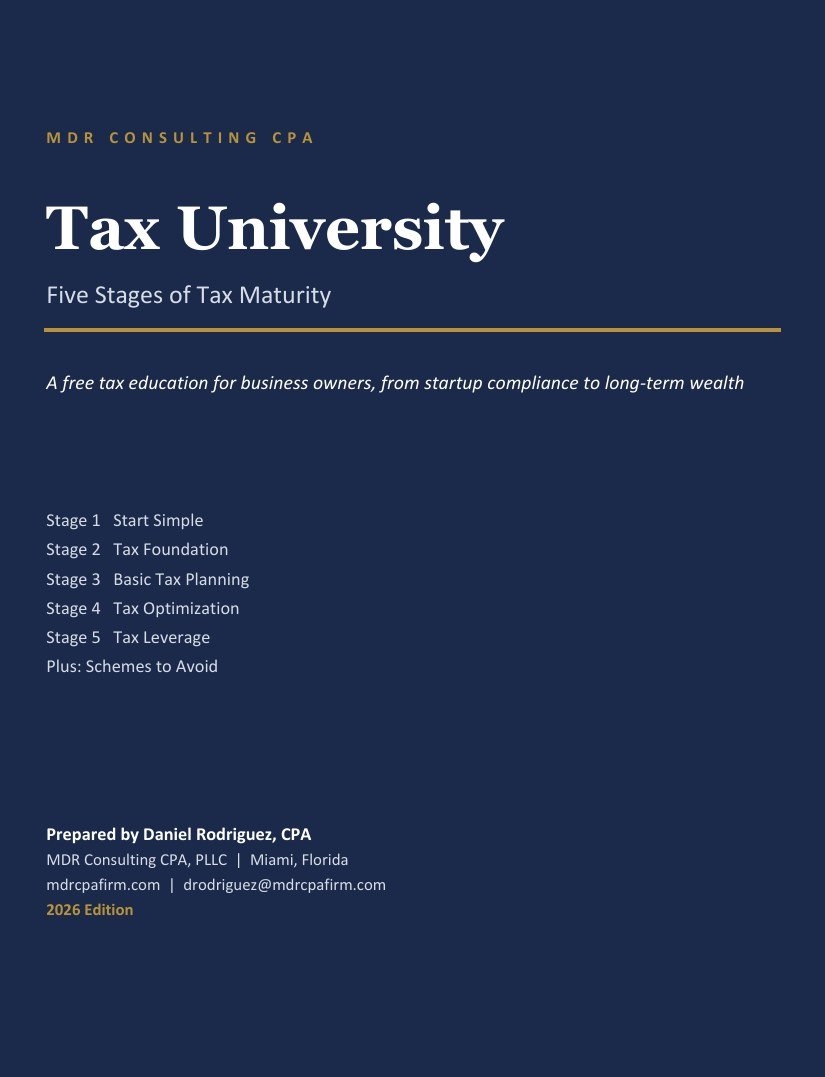
Want the full picture? Take Tax University, free.
A 48-page guide to the five stages of tax maturity, from setting up your business correctly to turning tax savings into wealth. Instant download.
Get Free Access →Is Your Business Getting the Full QBI Deduction?
If your income is near or above the threshold, salary, wages, and entity structure all change the result. I can calculate your deduction under a few scenarios before you file.
Schedule a Free ConsultationThis article is general information based on federal and Florida tax law. Figures are for the 2026 tax year unless noted. It is not tax or legal advice for your situation. Tax rules change, and the right answer depends on your facts, so talk with a qualified professional before acting on it.