Make Informed Tax Decisions Before the Year Ends, Not After.
Most of your tax bill is decided before December 31. I work with Florida business owners and high earners year-round to find the planning opportunities the tax law actually allows, document them properly, and stay clear of positions that do not hold up.
Tax Preparation vs. Strategic Tax Planning
If your accountant only asks for receipts in March, you have a record of what happened, not a tax strategy.
Reactive Tax Filing
- ✕Meets with you once a year after the tax year has already ended
- ✕Reports what you made and hands you a surprise tax bill
- ✕Misses S corp salary adjustments, resulting in audit risk or overpaid payroll taxes
- ✕No guidance on retirement plans, real estate, or entity structure until it is too late to act
Proactive CPA Tax Strategy
- ✓Quarterly touchpoints to forecast profit and act on strategies before December 31
- ✓Documented reasonable compensation for S corp owners, set from your duties and market data
- ✓Retirement plan options sized to your actual profit and cash flow
- ✓Equipment and vehicle purchases timed around Section 179 and bonus depreciation rules
Explore Tax Strategies by Topic
Plain explanations written by a CPA: what the law allows, who qualifies, the limits, and the situations where a strategy does not work.
Business Tax Planning
Deductions, depreciation, vehicles, family employment, and the timing decisions that shape your tax bill.
- Section 179 vs. Bonus Depreciation in 2026: Which One Should Your Business Use?
- Can You Deduct 100% of Your Business Vehicle? Section 179, Bonus Depreciation, and the 6,000-Pound Rule
- Can You Pay Your Children Through Your Business? The Rules, the Payroll Tax Exemption, and What It Takes
- The QBI Deduction Explained: How the 20% Pass-Through Deduction Works in 2026
- The Augusta Rule: Can You Rent Your Home to Your Business Tax Free?
- Year-End Tax Planning Checklist: Strategies Florida Businesses Must Execute Before December 31
- Mid-Year Tax Planning: 6 Strategic Moves for Florida Business Owners Before July
S Corporation Strategies
When an S corp makes sense, reasonable compensation, shareholder basis, and the mistakes that get expensive.
- S Corp Reasonable Compensation: What the IRS Looks For and How to Set a Salary You Can Defend
- When Does an S Corp Actually Save You Money? A Break-Even Analysis for Florida Business Owners
- Understanding S Corp Shareholder Basis: Why It Limits Your Losses and Taxes Your Distributions
- 9 Common S Corp Tax Mistakes That Can Get Expensive (And How to Fix Them)
- LLC vs S-Corp in Florida: Which Business Structure Saves You More in Taxes?
- How to Pay Yourself as an LLC Owner in Florida
Individual & High-Income Planning
Equity compensation, retirement accounts, charitable giving, and Florida residency for high earners.
- How RSUs Are Taxed: Vesting, Withholding Gaps, and the Cost Basis Mistake That Causes Double Taxation
- Tax Planning Strategies for High-Income Earners in Florida: What Works and What to Avoid
- Foreign Income, FBAR & FIRPTA: A Tax Guide for Miami Business Owners and Real Estate Investors
- Moving Your Business to Florida: Domicile Rules, Tax Savings, and What High-Tax States Audit
Real Estate Taxation
Depreciation, cost segregation, 1031 exchanges, and what happens when you sell a rental property.
Start Here
S Corp Reasonable Compensation: What the IRS Looks For and How to Set a Salary You Can Defend
Paying yourself a low salary and taking the rest as distributions is the main reason S corps save tax. It is also the issue the IRS raises most often with S corp owners. Here is how to set a number you can defend.
Section 179 vs. Bonus Depreciation in 2026: Which One Should Your Business Use?
Both Section 179 and bonus depreciation let you deduct equipment in the year you buy it. They follow different rules, and the 2025 tax law changed both. Here is how to choose between them before December 31.
When Does an S Corp Actually Save You Money? A Break-Even Analysis for Florida Business Owners
An S corp election can save thousands in self-employment tax, or cost more than it saves. The difference comes down to your profit, a reasonable salary, and costs that rarely show up in the sales pitch.
The Strategies Business Owners Ask About Most
Each of these is grounded in the Internal Revenue Code. Each also has requirements and limits, and I will tell you plainly when one does not fit your situation.
S Corporation Election & Salary
An S corporation can reduce self-employment tax on profit above a reasonable salary. The savings depend on how much profit is left after a defensible salary, payroll costs, and the effect on your QBI deduction.
The limit: Usually not worth it until net profit is well above a reasonable salary for your role.
Read the full explanation →Retirement Plans for Owners
A Solo 401(k) allows up to $72,000 in combined contributions for 2026, plus catch-ups. A cash balance plan can allow much larger deductions for owners with high, stable profits.
The limit: Cash balance plans require annual funding, actuarial costs, and contributions for eligible employees.
Section 179 & Bonus Depreciation
Qualifying equipment, software, and certain vehicles can be deducted in the year they are placed in service instead of over several years. 100% bonus depreciation is now permanent.
The limit: A deduction saves a fraction of what you spend. Buy for business need, then time the deduction.
Read the full explanation →Real Estate Tax Strategies
Cost segregation can accelerate depreciation on rental and commercial property, and a 1031 exchange can defer gain when you sell and reinvest.
The limit: Passive loss rules often limit what depreciation can offset, and depreciation is recaptured when you sell.
Read the full explanation →Augusta Rule & Home Office
Section 280A(g) lets you rent your home for 14 days or fewer a year without reporting the rent. When your S corp or partnership is the renter, it can deduct the rent.
The limit: Requires fair market rent, real meetings, and records. It does not work for a sole proprietorship.
Read the full explanation →Hiring Your Children
Paying your children for real work at a reasonable wage moves income to their lower bracket. In a sole proprietorship or parent-owned partnership, wages to children under 18 are also exempt from payroll taxes.
The limit: Requires age-appropriate work, timesheets, and payroll. Chores and paper-only wages do not qualify.
Read the full explanation →Reasonable Compensation Studies
The IRS requires S corp owners who work in the business to pay themselves a reasonable W-2 salary before taking distributions. Set it too high and you overpay payroll taxes. Set it too low and you invite an audit, back taxes, and penalties.
A reasonable compensation study gives you a documented, defensible salary figure. It is the foundation of every S corp tax plan I build.
What the IRS looks for →Role & Duties Analysis
I map the work you actually perform (management, sales, technical, administrative) and the hours spent on each.
Market Wage Benchmarking
Each role is priced against industry wage data for your region, business size, and experience level.
Salary vs. Distribution Plan
I set the W-2 salary, schedule distributions, and project the payroll tax savings for the year.
Audit-Ready Documentation
You receive a written report supporting the salary figure, kept on file in case the IRS ever asks.
Frequently Asked Tax Planning Questions
Pick the free guide that fits you
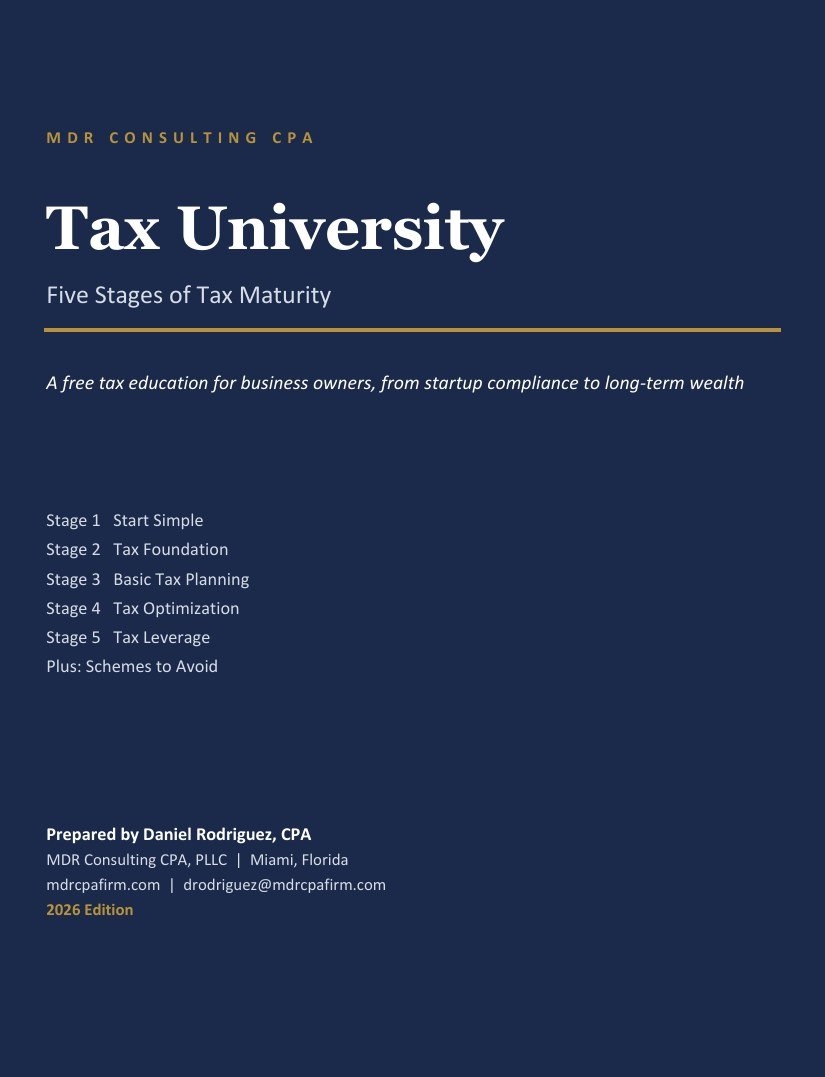
Tax University
Five Stages of Tax Maturity
From setting up your business correctly to turning tax savings into long-term wealth. 35 strategies across five stages.
Get Free Access →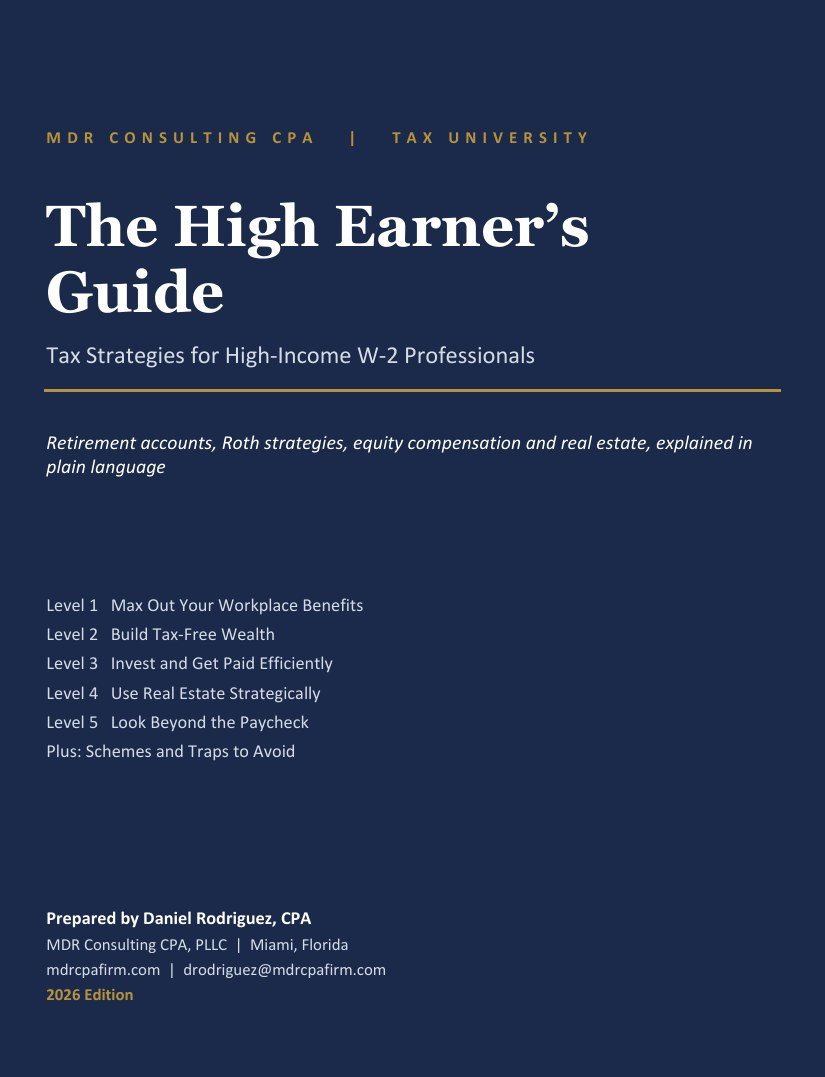
The High Earner's Guide
Tax Strategies for High-Income W-2 Professionals
Workplace benefits, backdoor and mega backdoor Roth, RSUs and stock options, and real estate strategies. 32 strategies across five levels.
Get Free Access →Build Your 2026/2027 Tax Plan
Most planning opportunities have a December 31 deadline. Schedule an initial strategy call with a licensed Florida CPA and find out which ones fit your situation.