9 Common S Corp Tax Mistakes That Can Get Expensive (And How to Fix Them)
When I take on a new S corporation client, the first year usually involves cleaning up a few problems from prior years. Very few of them come from aggressive tax planning. Most come from treating the S corp like a sole proprietorship with extra paperwork. Here are the mistakes I see most often, why each one matters, and how to fix it. The S corp return is due March 15, so this is a good checklist to run before it is filed.
1. Paying Yourself Too Little Salary, or None
Owners who work in the business must take a reasonable salary through payroll before taking distributions. Taking only distributions is the most common S corp audit issue, and the IRS has a long record of winning these cases. Fix it by setting a documented salary based on your duties and market data, and running it through payroll during the year.
2. Mixing Personal and Business Expenses
Paying personal bills from the business account and calling them business expenses is the fastest way to lose deductions in an audit. Paying them and recording them as distributions is better, but it can still throw off basis and the balance of distributions among owners. Keep personal spending out of the business account entirely and take distributions as separate, recorded transfers.
3. Health Insurance Not on the W-2
For shareholders who own more than 2% of an S corp, health insurance premiums paid by the company must be included in W-2 wages in box 1. They are not subject to Social Security or Medicare tax if paid under a plan for employees. Reporting them this way is what allows you to take the self-employed health insurance deduction on your personal return. When the premiums are left off the W-2, the deduction can be lost.
4. Distributions That Do Not Match Ownership
An S corporation can have only one class of stock, which means distributions must follow ownership percentages. If one 50% owner takes $80,000 and the other takes $30,000, the difference can raise a second class of stock argument, which in the worst case can terminate the election. If distributions have become uneven, make corrective distributions before year end and document them.
5. Not Tracking Shareholder Basis
Basis determines whether losses are deductible and whether distributions are tax free. Neither the company's books nor the K-1 tracks it, and Form 7203 now requires you to report it in many years. Without a basis schedule, owners often discover the problem only when they sell the business or take a large distribution.
6. Ineligible Shareholders
S corporation shareholders must generally be U.S. citizens or resident individuals, certain trusts, and estates. A nonresident alien shareholder terminates the election. In South Florida, this comes up when a family member abroad is given shares, when an owner moves out of the country, or when shares pass to a foreign heir. Check eligibility before any ownership change, not after.
7. No Accountable Plan for Reimbursements
As an employee of your S corp, you cannot deduct unreimbursed business expenses on your personal return. Mileage on your personal car, a home office, or a business phone should be reimbursed by the company under a written accountable plan. Reimbursements under the plan are deductible to the company and tax free to you, as long as you substantiate them and return any excess.
8. Undocumented Loans Between You and the Company
Money moving between you and the S corp without paperwork creates confusion about whether it is a loan, a contribution, a distribution, or wages. Without a note, interest terms, and repayments, the IRS can recharacterize the transaction. If you lend money to the company or borrow from it, document it as a loan from the start.
9. Distributing Appreciated Property
Moving a vehicle, equipment, or real estate out of an S corp to yourself is treated as if the company sold it at fair market value. The gain passes through to you and is taxable, even though no cash changed hands. This is why real estate rarely belongs in an S corp. The question of how to get appreciated property out tax free usually has no good answer once it is in.
Many S corporations have none of these issues, especially when the owner runs payroll, keeps business and personal funds separate, and has the return prepared by someone who looks past the books. If you are unsure, a one-time review of the last two or three returns usually shows quickly whether there is anything to address.
References

Daniel is a Florida CPA and the principal of MDR Consulting CPA PLLC in Miami. He works with small businesses, self-employed professionals, and high earners on tax compliance and planning, in English and Spanish. Before starting the firm he led accounting and finance teams as VP of Finance at Alivi and Director of Accounting at Assurant.
More about Daniel →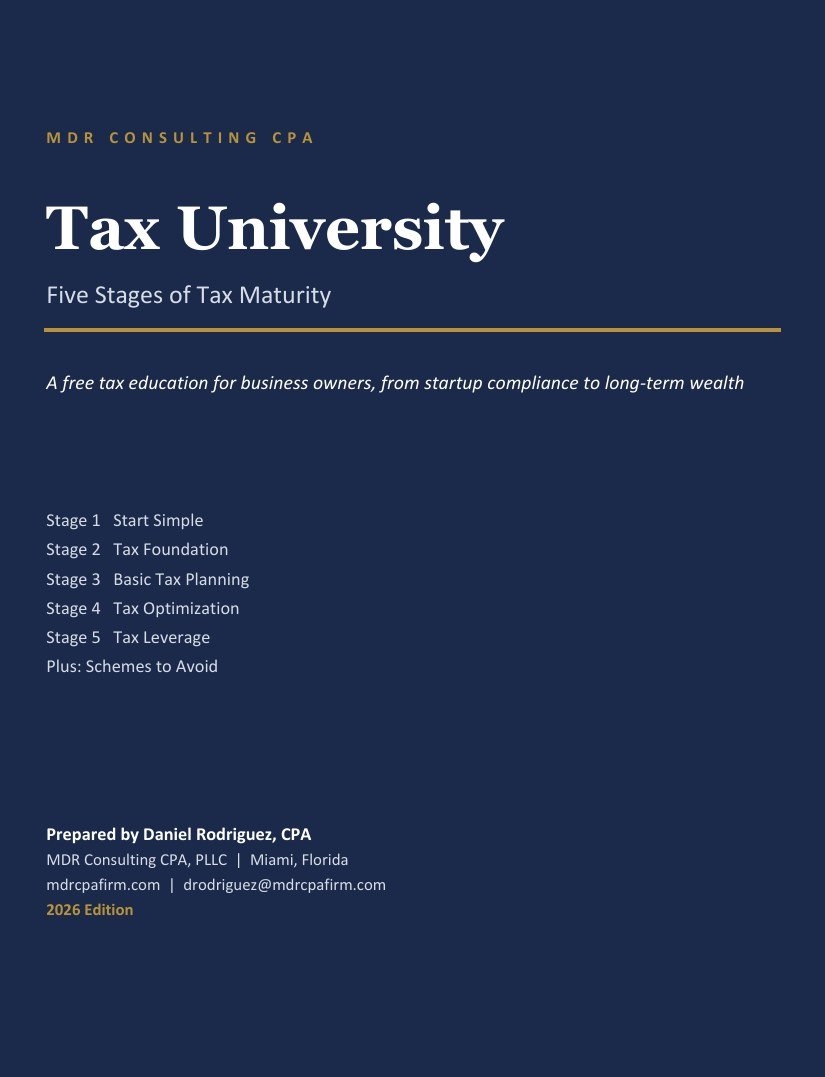
Want the full picture? Take Tax University, free.
A 48-page guide to the five stages of tax maturity, from setting up your business correctly to turning tax savings into wealth. Instant download.
Get Free Access →Want a Second Look at Your S Corp?
I review prior S corp returns for these issues and fix what can be fixed before it becomes a bigger problem. If your return has not been filed yet this year, there is still time.
Schedule a Free ConsultationThis article is general information based on federal and Florida tax law. Figures are for the 2026 tax year unless noted. It is not tax or legal advice for your situation. Tax rules change, and the right answer depends on your facts, so talk with a qualified professional before acting on it.