S Corp Reasonable Compensation: What the IRS Looks For and How to Set a Salary You Can Defend
If you own an S corporation and work in the business, the IRS expects you to pay yourself a reasonable salary through payroll before you take distributions. Owners often ask me what that number should be. The honest answer is that no rule or percentage settles it. What exists is a set of factors the IRS and the courts have applied for decades, and a clear pattern of what happens to owners who ignore them. This article walks through both, so you can see where your own salary stands.
Why Salary Matters So Much in an S Corp
Salary paid to an S corp owner is subject to Social Security and Medicare taxes, a combined 15.3% split between the company and the employee. The Social Security portion applies up to the 2026 wage base of $184,500. The Medicare portion has no cap, and an additional 0.9% applies to wages above $200,000 for single filers or $250,000 for married couples filing jointly.
Distributions are not subject to those taxes. That difference is the entire payroll tax benefit of an S corp, and it creates an obvious temptation to keep salary as low as possible. As a rough guide, every $10,000 moved from salary to distributions saves about $1,530 in combined payroll taxes when you are below the wage base.
When the IRS concludes that a salary is unreasonably low, it can reclassify distributions as wages and assess the payroll taxes that should have been paid, plus penalties and interest, for every open year.
What the Law and the Courts Say
No section of the Internal Revenue Code sets a salary number. The requirement comes from the definition of wages: payment for services is wages no matter what the company calls it. The IRS has held since Revenue Ruling 74-44 that payments labeled as dividends can be treated as wages when they are really compensation for work.
The courts have consistently agreed. In Watson v. United States (8th Cir. 2012), a CPA paid himself a $24,000 salary while taking more than $175,000 a year in distributions from his firm. The court upheld the IRS position that a reasonable salary was about $91,000 and that the difference was wages. In Joseph Radtke, S.C. v. United States (7th Cir. 1990), an attorney who took no salary at all and paid himself only through dividends lost the same argument.
The pattern in these cases is consistent. When the owner is the main reason the business earns money and the salary is a small fraction of what the business pays out, the IRS usually wins.
The Factors the IRS Considers
IRS guidance on S corporation officer compensation lists the factors examiners and courts look at. None of them is decisive alone. Together they describe what an unrelated business would have to pay someone to do your job.
- Your training and experience
- Your duties and responsibilities in the business
- The time and effort you devote to the business
- The company's history of distributions compared with salary
- What the company pays non-owner employees
- The timing and manner of bonuses paid to key people
- What comparable businesses pay for similar services
- Any compensation agreements
- Whether a formula was used to set compensation
Three Ways to Set a Defensible Salary
In practice, a reasonable compensation analysis uses one or more of three approaches.
- Market approach: what would it cost to hire someone with your skills to do your job? Wage surveys such as the Bureau of Labor Statistics Occupational Employment and Wage Statistics give a starting point by occupation and region.
- Cost approach: most small business owners wear several hats. You might spend 40% of your time as a manager, 40% doing technical work, and 20% on administration. Each role is priced at its own market rate and weighted by the time spent.
- Income approach: after paying you a market salary, would an outside investor still earn a fair return on the capital in the business? If almost nothing would be left for an investor, the salary is probably too low.
The 60/40 Rule Is Not a Rule
You may have heard that S corp owners should split profit 60% salary and 40% distributions, or the reverse. No IRS rule, regulation, or court case supports either split. It is a shortcut that can produce a reasonable number by accident, but it is not evidence. If the IRS asks how your salary was set, the answer needs to be your duties, your hours, and market data, not a ratio.
Trade-Offs of a Low Salary
Even when a lower salary is defensible, lower is not always better.
- Retirement contributions: employer contributions to a Solo 401(k) are limited to 25% of your W-2 salary. A low salary can cap how much you can put away.
- Social Security benefits: your future benefit is based on wages subject to Social Security tax. Lower wages today can mean a smaller benefit later.
- QBI deduction: salary reduces qualified business income, but above certain income levels the deduction is also limited by W-2 wages paid. The right salary can be the one that balances both.
When a Low Salary Does Not Hold Up
These are the situations where I would expect the IRS to challenge an owner's salary.
- A professional practice where the owner personally produces most of the revenue, such as consulting, medicine, law, accounting, or engineering
- No salary at all while the owner takes regular distributions
- A salary that has stayed the same for years while profit has grown
- A salary lower than what the business pays employees with less responsibility
- Salary paid once a year with no payroll withholding, or not run through payroll at all
The requirement applies to owners who perform services and take distributions. A shareholder who does not work in the business does not need a salary. A company with little or no profit to distribute can often justify a low salary, because there is nothing being shifted from wages to distributions. The question is always what the cash paid to you was really for.
How to Document Your Salary
Documentation is what turns a salary number into a defensible position. At a minimum, keep a written record of your duties and approximate hours, the wage data you relied on, and how you arrived at the figure. Revisit it each year as the business changes. Then run the salary through payroll with proper withholding and quarterly filings, the same way you would for any employee.
If the IRS ever questions your salary, a study prepared at the time the salary was set carries far more weight than an explanation assembled after the notice arrives.
References

Daniel is a Florida CPA and the principal of MDR Consulting CPA PLLC in Miami. He works with small businesses, self-employed professionals, and high earners on tax compliance and planning, in English and Spanish. Before starting the firm he led accounting and finance teams as VP of Finance at Alivi and Director of Accounting at Assurant.
More about Daniel →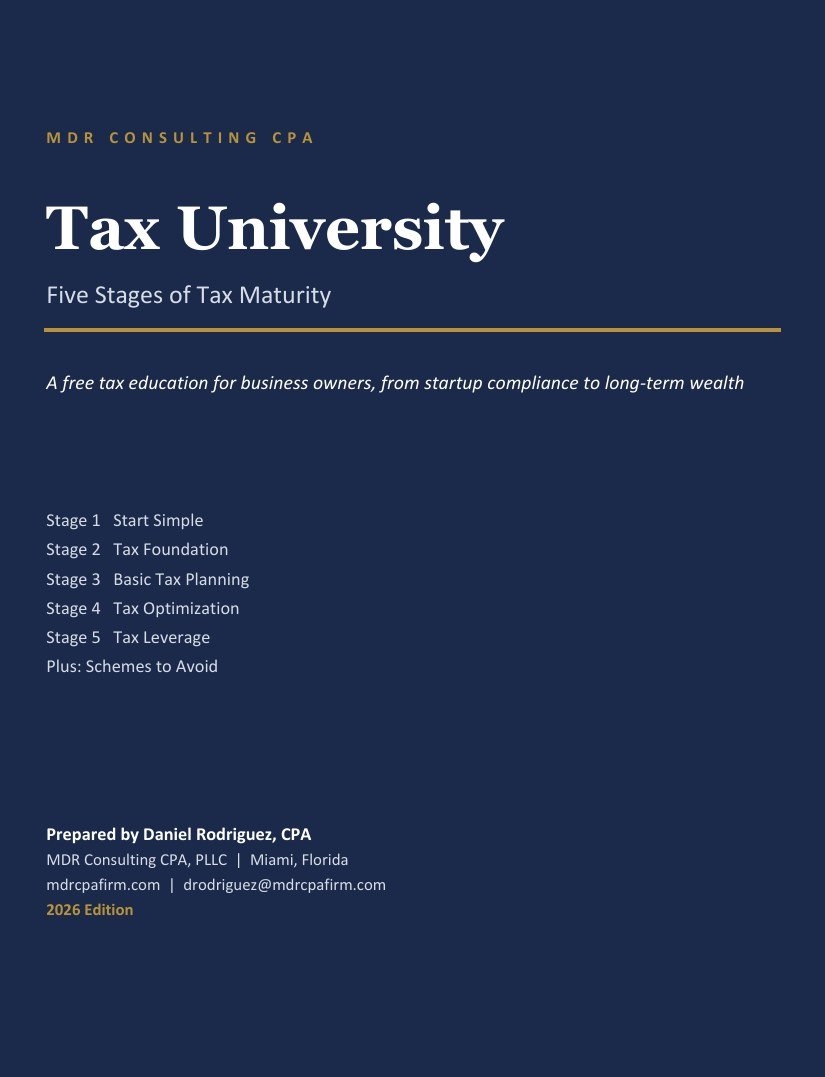
Want the full picture? Take Tax University, free.
A 48-page guide to the five stages of tax maturity, from setting up your business correctly to turning tax savings into wealth. Instant download.
Get Free Access →Not Sure Your S Corp Salary Would Hold Up?
I prepare reasonable compensation studies that document how your salary was set, using your actual duties and current market wage data. If your salary has not changed in years, or you are not sure how it was chosen, schedule a free consultation.
Schedule a Free ConsultationThis article is general information based on federal and Florida tax law. Figures are for the 2026 tax year unless noted. It is not tax or legal advice for your situation. Tax rules change, and the right answer depends on your facts, so talk with a qualified professional before acting on it.